Pages

Monday, August 6, 2018

arXiv:1808.00609 - The excitation of a primordial cold asteroid belt as an outcome of the planetary instability

PaperThe excitation of a primordial cold asteroid belt as an outcome of the planetary instability
AuthorsRogerio Deienno, Andre Izidoro, Alessandro Morbidelli, Rodney S. Gomes, David Nesvorny, Sean N. Raymond
Abstract: The main asteroid belt (MB) is low in mass but dynamically excited. Here we propose a new mechanism to excite the MB during the giant planet ('Nice model') instability, which is expected to have featured repeated close encounters between Jupiter and one or more ice giants ('Jumping Jupiter' -- JJ). We show that, when Jupiter temporarily reaches a high enough level of excitation, both in eccentricity and inclination it induces strong forced vectors of eccentricity and inclination across the MB region. Because during the JJ instability Jupiter's orbit `jumps' around, the forced vectors keep changing both in magnitude and phase throughout the whole MB region. The entire cold primordial MB is thus excited as a natural outcome of the JJ instability. The level of such an excitation, however, is typically larger than the current orbital excitation observed in the MB. We show that the subsequent evolution of the Solar System is capable of reshaping the resultant over-excited MB to its present day orbital state, and that a strong mass depletion (∼90%) is associated to the JJ instability phase and its subsequent evolution throughout the age of the Solar System

My Comment: Solar System dynamics are what drew me into astronomy in the first place. More than any results of this paper, I find it absolutely stellar as it clearly explains what is being simulated, and why, and points the reader at additional sources of information on the particulars. In sense it manages to not only present the science that was done, but also how that science was accomplished.

My Scrawling Notes:

Wednesday, August 1, 2018

arXiv:1807.11496 - Gaia: Orion's Integral Shaped Filament is a Standing Wave

PaperGaia: Orion's Integral Shaped Filament is a Standing Wave
AuthorsAmelia M. Stutz, Valentina I. Gonzalez-Lobos, Andrew Gould
Abstract: The Integral Shaped Filament (ISF) is the nearest molecular cloud with rapid star formation, including massive stars, and it is therefore a star-formation laboratory. We use Gaia parallaxes, to show that the distances to young Class II stars ('disks') projected along the spine of this filament are related to the gas radial velocity by
v=Dτ+K;τ=4Myr,
where K is a constant. This implies that the ISF is a standing wave, which is consistent with the Stutz & Gould (2016) 'Slingshot' prediction. The τ=4Myr timescale is consistent with the 'Slingshot' picture that the Orion Nebula Cluster (ONC) is the third cluster to be violently split off from the Orion A cloud (following NGC 1981 and NGC 1987) at few-Myr intervals due to gravito-magnetic oscillations. We also present preliminary evidence that the truncation of the ISF is now taking place 16′ south of the ONC and is mediated by a torsional wave that is propagating south with a characteristic timescale τtorsion=0.5Myr, i.e. eight times shorter. The relation between these two wave phenomena is not presently understood.

My Comment: Dear students: this (one reason) why it is important to understand simple waves. 

My Scrawling Notes:

Tuesday, July 31, 2018

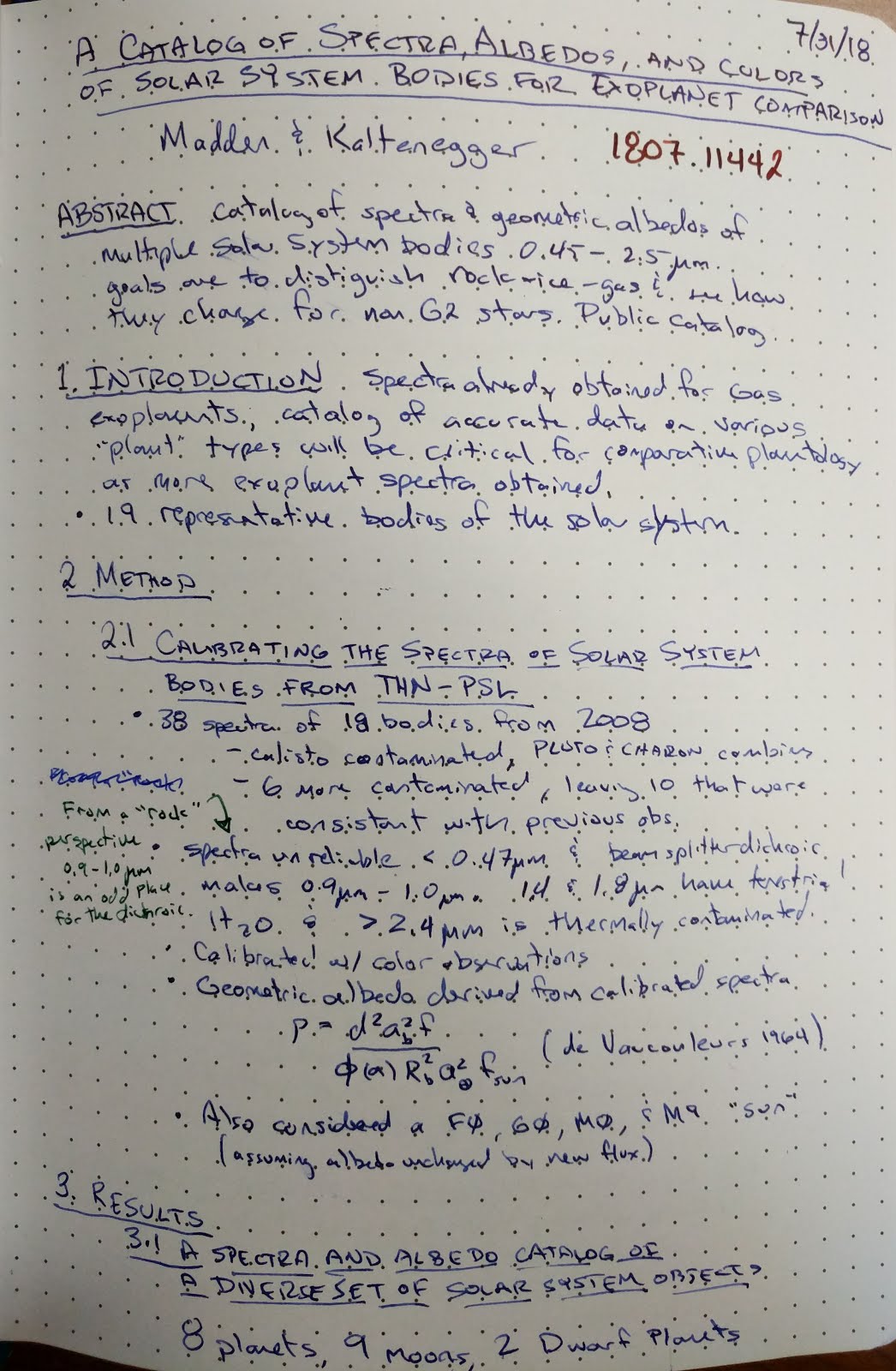
arXiv:1807.11442 - A Catalog of Spectra, Albedos, and Colors of Solar System Bodies for Exoplanet Comparison

PaperA Catalog of Spectra, Albedos, and Colors of Solar System Bodies for Exoplanet Comparison
AuthorsJ. H. Madden, Lisa Kaltenegger
Abstract: We present a catalog of spectra and geometric albedos, representative of the different types of Solar System bodies, from 0.45 to 2.5 microns. We analyzed published calibrated, un-calibrated spectra, and albedos for Solar System objects and derived a set of reference spectra and reference albedo for 19 objects that are representative of the diversity of bodies in our Solar System. We also identified previously published data that appears contaminated. Our catalog provides a baseline for comparison of exoplanet observations to 19 bodies in our own Solar System, which can assist in the prioritization of exoplanets for time-intensive follow-up with next-generation Extremely Large Telescopes (ELTs) and space-based direct observation missions. Using high and low-resolution spectra of these Solar System objects, we also derive colors for these bodies and explore how a color-color diagram could be used to initially distinguish between rocky, icy, and gaseous exoplanets. We explore how the colors of Solar System analog bodies would change when orbiting different host stars. This catalog of Solar System reference spectra and albedos is available for download through the Carl Sagan Institute.

My Comment: This is cool stuff. In order to have a clue as to what we will (soon) be looking at in terms of exoplanets we need to know what the worlds that we have access to would look like as exoworlds. This (public) catalog is a nice first step. Clearly acknowledging several issues that arose in making it, it lays out a nice guideline as to how to make a first-pass at guessing if you are looking at a rocky or icy surface, or at a whole bunch of gas.  Also: Venus is hard.

My Scrawling Notes:

Monday, July 30, 2018

arXiv:1807.10612 - Cluster kinematics and stellar rotation in NGC 419 with MUSE and adaptive optics

PaperCluster kinematics and stellar rotation in NGC 419 with MUSE and adaptive optics
AuthorsSebastian Kamann, Nathan J. Bastian, Tim-Oliver Husser, Silvia Martocchia, Christopher Usher, Mark den Brok, Stefan Dreizler, Andreas Kelz, Davor Krajnović, Johan Richard, Matthias Steinmetz, Peter M. Weilbacher
Abstract: We present adaptive optics (AO) assisted integral-field spectroscopy of the intermediate-age star cluster NGC 419 in the Small Magellanic Cloud. By investigating the cluster dynamics and the rotation properties of main sequence turn-off stars (MSTO), we demonstrate the power of AO-fed MUSE observations for this class of objects. Based on 1 049 radial velocity measurements, we determine a dynamical cluster mass of 1.4+/-0.2x10^5 M_sun and a dynamical mass-to-light ratio of 0.67+/-0.08, marginally higher than simple stellar population predictions for a Kroupa initial mass function. A stacking analysis of spectra at both sides of the extended MSTO reveals significant rotational broadening. Our analysis further provides tentative evidence that red MSTO stars rotate faster than their blue counterparts. We find average V sin i values of 87+/-16 km/s and 130+/-22 km/s for blue and red MSTO stars, respectively. Potential systematic effects due to the low spectral resolution of MUSE can reach 30 km/s but the difference in V sin i between the populations is unlikely to be affected.

My Comment: The first two "research" assignments I ever had in graduate school involved star clusters and cluster dynamics. This was a bit perplexing as I was looking to work on solar system dynamics, and only knew that a "cluster" was a group of gravitationally bound stars from reading through an introductory astronomy text prior to being a TA; the only serious astronomy I had done as an undergrad was to work out the transformations of taking earth-based observations into orbits. 

My Scrawling Notes:

Friday, July 27, 2018

arXiv:1807.09806 -- Young and eccentric: the quadruple system HD 86588

PaperYoung and eccentric: the quadruple system HD 86588
AuthorsAndrei Tokovinin, Hank Corbett, Octavi Fors, Ward Howard, Nicholas M. Law, Maxwell Moe, Frederick M. Walter
Abstract: High-resolution spectroscopy and speckle interferometry reveal the young star HD 86588 as a quadruple system with a 3-tier hierarchy. The 0.3" resolved binary A,B with an estimated period around 300 years contains the 8-year pair Aa,Abc (also potentially resolvable), where Ab,Ac is a double-lined binary with equal components, for which we compute the spectroscopic orbit. Despite the short period of 2.4058 day, the orbit of Ab,Ac is eccentric (e=0.086+-0.003). It has a large inclination, but there are no eclipses; only a 4.4 mmag light modulation apparently caused by star spots on the components of this binary is detected with Evryscope. Assuming a moderate extinction of A_V = 0.5 mag and a parallax of 5.2 mas, we find that the stars are on or close to the main sequence (age >10 Myr) and their masses are from 1 to 1.3 solar. We measure the strength of the Lithium line in the visual secondary B which, together with rotation, suggests that the system is younger than 150 Myr. This object is located behind the extension of the Chamaeleon I dark cloud (which explains extinction and interstellar Sodium absorption), but apparently does not belong to it. We propose a scenario where the inner orbit has recently acquired its high eccentricity through dynamical interaction with the outer two components; it is now undergoing rapid tidal circularization on a time scale of ~1 Myr. Alternatively, the eccentricity could be excited quasi-stationary by the outer component Aa.

My Comment: I love crazy dynamical systems. Two stars orbit each other as a binary. That binary orbits with another star as a compound binary. That compound (3-star) binary orbits with yet another star, making the whole system a three-level binary set of four stars. Really neat stuff.

My Scrawling Notes:

Wednesday, July 25, 2018

arXiv:1807.08322 -- Pre-airburst Orbital Evolution of Earth's Impactor 2018 LA: An Update

PaperPre-airburst Orbital Evolution of Earth's Impactor 2018 LA: An Update
Authors:C. de la Fuente Marcos, R. de la Fuente Marcos 
Abstract: Apollo meteoroid 2018 LA has become only the third natural object ever to be discovered prior to causing a meteor airburst and just the second one to have its meteorites recovered (at Botswana's Central Kalahari Game Reserve). Here, we use the latest orbit determination of 2018 LA (solution date 18-July-2018) to search for minor bodies moving in paths comparable to that of 2018 LA using the D-criteria, which are metrics to study orbit similarity, and N-body simulations. Our results further confirm the existence of a dynamical grouping of asteroids that might be related to 2018 LA and show that the impactor could be a recent fragment spawned by a larger object, the 550-m wide, potentially hazardous asteroid (454100) 2013 BO73. Spectroscopic observations of 454100 during its next flyby with our planet (brightest at an apparent visual magnitude of 18.4 on 2018 mid-November) may confirm or deny a putative similar chemical composition to that of the recovered meteorites of 2018 LA.

My Comment: A second very short letter (busy week this), but it does something very remarkable, very hard, and very needed -- attempting to link the space rocks on the ground to the rocks in space. For the most part all we can do is try to match spectra of meteorite samples in the lab to the reflectance spectra of asteroids in space. It is filled with many pitfalls. This is really neat as it gives a second diagnostic tool to work with - the dynamics of the impactor's orbit.

My Scrawling Notes:

Tuesday, July 24, 2018

arXiv:1807.08728 -- P/2017 S5: Another Active Asteroid Associated with the Theobalda Family

PaperP/2017 S5: Another Active Asteroid Associated with the Theobalda Family
AuthorsBojan Novakovic
Abstract: In this note we have shown that a newly discovered comet P/2017 S5 (ATLAS), that moves around the Sun in an asteroid-like orbit, is a member of the Theobalda asteroid family.

My Comment: Super short letter, but packed full of references giving a clear "how you do this science" outline. Love it. One of my favorite experiences with an undergrad research student was when she serendipitously found a candidate active asteroid while working with me on a comet project. Turns out it (most likely) wasn't but working out that puzzle involved her getting time on a 3.5m telescope(!), and having her work praised by Jocelyn Bell Burnell(!!).

My Scrawling Notes: