Pages

Showing posts with label Kuiper Belt. Show all posts

Friday, August 17, 2018

arXiv 1808.02618: Earth and Planetary Astrophysics OSSOS: XIII. Fossilized Resonant Dropouts Imply Neptune's Migration was Grainy and Slow

Paper: OSSOS: XIII. Fossilized Resonant Dropouts Imply Neptune's Migration was Grainy and Slow
Authors: S. M. Lawler, R. E. Pike, N. Kaib, M. Alexandersen, M. T. Bannister, Y.-T. Chen, B. Gladman, S. Gwyn, J. J. Kavelaars, J.-M. Petit, K. Volk
Abstract: The migration of Neptune's resonances through the early Kuiper belt has left signatures of the migration timescale and mode in the distribution of small bodies in the outer Solar System. Here we analyze five published Neptune migration models in detail, focusing on the high pericenter distance (q) trans-Neptunian Objects (TNOs) near Neptune's mean-motion resonances. We focus on the TNOs near the 5:2 and 3:1 resonances, because they have large detected populations, are outside the main classical belt, and are relatively isolated from other strong resonances. We compare the observationally biased output from these dynamical models with the detected TNOs from the Outer Solar System Origins Survey, via its Survey Simulator. All of the four new OSSOS detections of high-q non-resonant TNOs are on the Sunward side of the 5:2 and 3:1 resonances. We show that even after accounting for observation biases, this asymmetric distribution cannot be drawn from a uniform distribution of TNOs at 2-sigma confidence. We find that the dynamical model that uses grainy slow Neptune migration provides the best match to the real TNO orbital data. However, due to extreme observational biases, we have very few high pericenter distance TNO discoveries with which to statistically constrain the models. We show that a deeper survey (to a limiting r-magnitude of 26.0) with a similar survey area to OSSOS could statistically distinguish between these five Neptune migration models. We speculate that the cycle of resonance sticking and Kozai oscillation within a resonance, followed by resonant dropout into this fossilized high-q population, could potentially explain all but the two very highest-q TNOs discovered to date.

My Comment: To me this is so very much the heart of astronomy science. We very rarely can do an experiment in the lab, so we have to do as much as possible with what we are able to observe. Our theories must be realized by careful simulation of what the physics say they do, and then must be carefull compared to well-characterized observations.

My Scrawling Notes:


Wednesday, July 11, 2018

arXiv:1807.02960 -- Outer solar system possibly shaped by a stellar fly-by

Paper: Outer solar system possibly shaped by a stellar fly-by
Authors: Susanne Pfalzner, Asmita Bhandare, Kirsten Vincke, Pedro Lacerda
Abstract: The planets of our solar system formed from a gas-dust disk. However, there are some properties of the solar system that are peculiar in this context. First, the cumulative mass of all objects beyond Neptune (TNOs) is only a fraction of what one would expect. Second, unlike the planets themselves, the TNOs do not orbit on coplanar, circular orbits around the Sun, but move mostly on inclined, eccentric orbits and are distributed in a complex way. This implies that some process restructured the outer solar system after its formation. However, some of TNOs, referred to as Sednoids, move outside the zone of influence of the planets. Thus external forces must have played an important part in the restructuring of the outer solar system. The study presented here shows that a close fly-by of a neighbouring star can simultaneously lead to the observed lower mass density outside 30 AU and excite the TNOs onto eccentric, inclined orbits, including the family of Sednoids. In the past it was estimated that such close fly-bys are rare during the relevant development stage. However, our numerical simulations show that such a scenario is much more likely than previously anticipated. A fly-by also naturally explains the puzzling fact that Neptune has a higher mass than Uranus. Our simulations suggest that many additional Sednoids at high inclinations still await discovery, perhaps including bodies like the postulated planet X.

My Comment: Fun discussion of solar system shaping mechanism and conducted further work to show plausibility of a fly-by during very early (10Myr) Solar System. Got me thinking about the Tisserand parameter with respect to Neptune, and once again am very happy to have astro-twitter folks willing to point papers and ideas out to me!

My Scrawling Notes:

Monday, June 25, 2018

The New Horizons Kuiper Belt Extended Mission - arXiv:1806.08393

Paper: The New Horizons Kuiper Belt Extended Mission 
Authors: S.A. Stern, H.A. Weaver, J.R. Spencer, H.A. Elliott, the New Horizons Team
Abstract: The central objective of the New Horizons prime mission was to make the first exploration of Pluto and its system of moons. Following that, New Horizons has been approved for its first extended mission, which has the objectives of extensively studying the Kuiper Belt environment, observing numerous Kuiper Belt Objects (KBOs) and Centaurs in unique ways, and making the first close flyby of the KBO 486958 2014 MU69. This review summarizes the objectives and plans for this approved mission extension, and briefly looks forward to potential objectives for subsequent extended missions by New Horizons.

My Comment: Two and a half days before closest encounter, the extended mission target 2014 MU69 will finally be 2 pixels on the LORRI instrument. That's um... rather quick!

My Scrawling Notes:

Page 1
Page 2
Page 3

Friday, July 20, 2012

And then there were five…

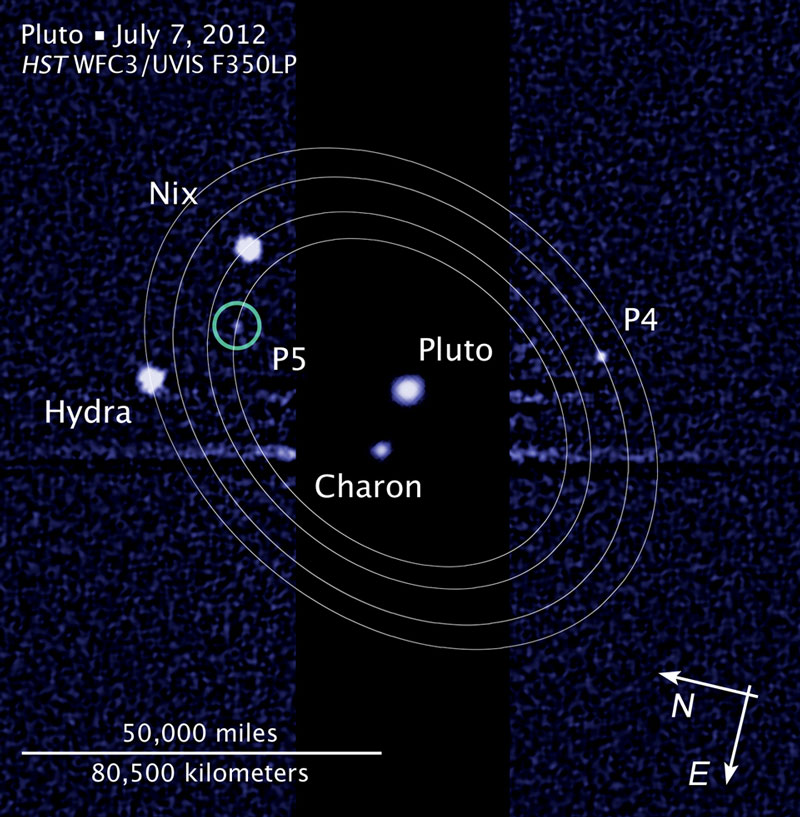
134340 Pluto has a new moon, bringing the distant dwarf planet’s collection of satellites to 5.  No official name for the little guy yet, but this 10 to 25 km piece of (more than likely) ice takes about 20 days to orbit Pluto at a distance of about 42,000 km, placing it between Charon (the largest and innermost know moon) and Nix.  With the New Horizons probe on the way to Pluto, the little world’s family of moons continues to grow.See Explanation.  Clicking on the picture will download<br /> the highest resolution version available.
Pluto’s system of five moons.  Pluto and Charon are added into this composite image from a different source – the light from them needs to be blocked in order to make out the much fainter satellites.

Pluto’s first satellite, Charon was discovered by James Christy in 1978.  He noticed a “bump” in the images of Pluto that changed position (and even disappeared) from image to image.  Since then studies of Charon has allowed for much better mass measurements of Pluto, as well as revealing information about the moon itself.  Charon is, in relation to its parent, the largest object we consider a “moon.”   Charon’s diameter is about half that of Pluto, with 12% the dwarf planet’s mass.  Compare that to the Earth-Moon system: our Moon is about a quarter the diameter of the Earth in size with only 1.2% of the mass of the Earth, and our Moon is abnormally large compared to most planetary satellites (e.g. Saturn’s largest moon Titan is about than .02% the mass of Saturn!).  Charon is so massive compared to Pluto that it causes Pluto to actually orbit a point ouside of itself in space.  Really Pluto-Charon could be considered a double dwarf planet (or a binary Kuiper Belt Object) as they both orbit around a point partway between each other.

File:Charon Discovery.jpg
Now you see me now you don’t: The “bump” that would become known as Charon is visible to the upper right of Pluto in the first image, but not in the second.

Charon and Pluto are also tidally locked to one another, Pluto’s rotation, the rotation of Charon and the the orbit of Charon all take the same amount of time, roughly 6 days, 9 hours.  This situation results Pluto and Charon always “facing” each other.  Charon will always be in the same place in the sky for an observer on Pluto (and the other way around too!).


The rest of Pluto’s family of satellites are more recent discoveries.  The dwarf planet had been under detailed study to prepare for the New Horizon’s mission, which was launched in 2006, and is scheduled to fly-by Pluto and its moons in 2015.   By blocking the light from the bright sources of Pluto and Charon, the region near Pluto may be searched for additional, small and faint bodies.  In 2005 a team conduced a search for companions of Pluto using the Hubble Space Telescope and discovered two new satellites of Pluto, later officially designated Nix and Hydra.  In 2011 a 4th moon of Pluto was discovered, “P4”  Which brings us up to today, with the recent announcement that a 5th moon of Pluto, “P5” had been identified through HST images.  All four of these newer moons are pretty small, with the largest one, Hydra, between 60 to 170 km across, while the smallest moon,  the newly discovered “P5,” being only 10-25 km in diameter.  Quite a bit of the uncertainty in size comes from not knowing how reflective these moons are.  If they have very dark surfaces, they will be larger than if they had very reflective surfaces since these size estimates are based on how bright the sunlight is that has reflected off of their surface and been collected by our telescopes.


Of interest is the relationship that the orbits of Pluto’s moons have with each other.  They are all very close to mean motion resonances with the Pluto-Charon system.  From closest P5, Nix, P4, and Hydra are almost in a 1:3:4:5:6 resonance with the Pluto-Charon.  That means that every 6th time Charon orbits Pluto, P5 will have completed 5 orbits, Nix will complete 4, P4 will have completed 3 and Hydra will have finished one orbit of Pluto.  Details are being studied right now, but it seems as though none of them are in a “perfect” resonance – but the orbital dynamics of the Pluto system are getting very interesting indeed.


In fact a colleague of mine, Dr. Alex Parker at the Harvard–Smithsonian Center for Astrophysics, has made a wonderful demonstration of how close to resonance these moons are.  By translating their orbital frequency into sound, and boosting it by 29 octaves (to be in the auditory range) Dr. Parker has turned the Plutonian orbits into “music”.  One can visit his SoundCloud page: http://soundcloud.com/alexhp-1/plutos-five-moons and hear the slight difference between a perfect resonance, and what we have measured the Plutonian system to be in.  Seriously, check it out – it is super cool.