Pages

Showing posts with label extrasolar. Show all posts

Tuesday, July 31, 2018

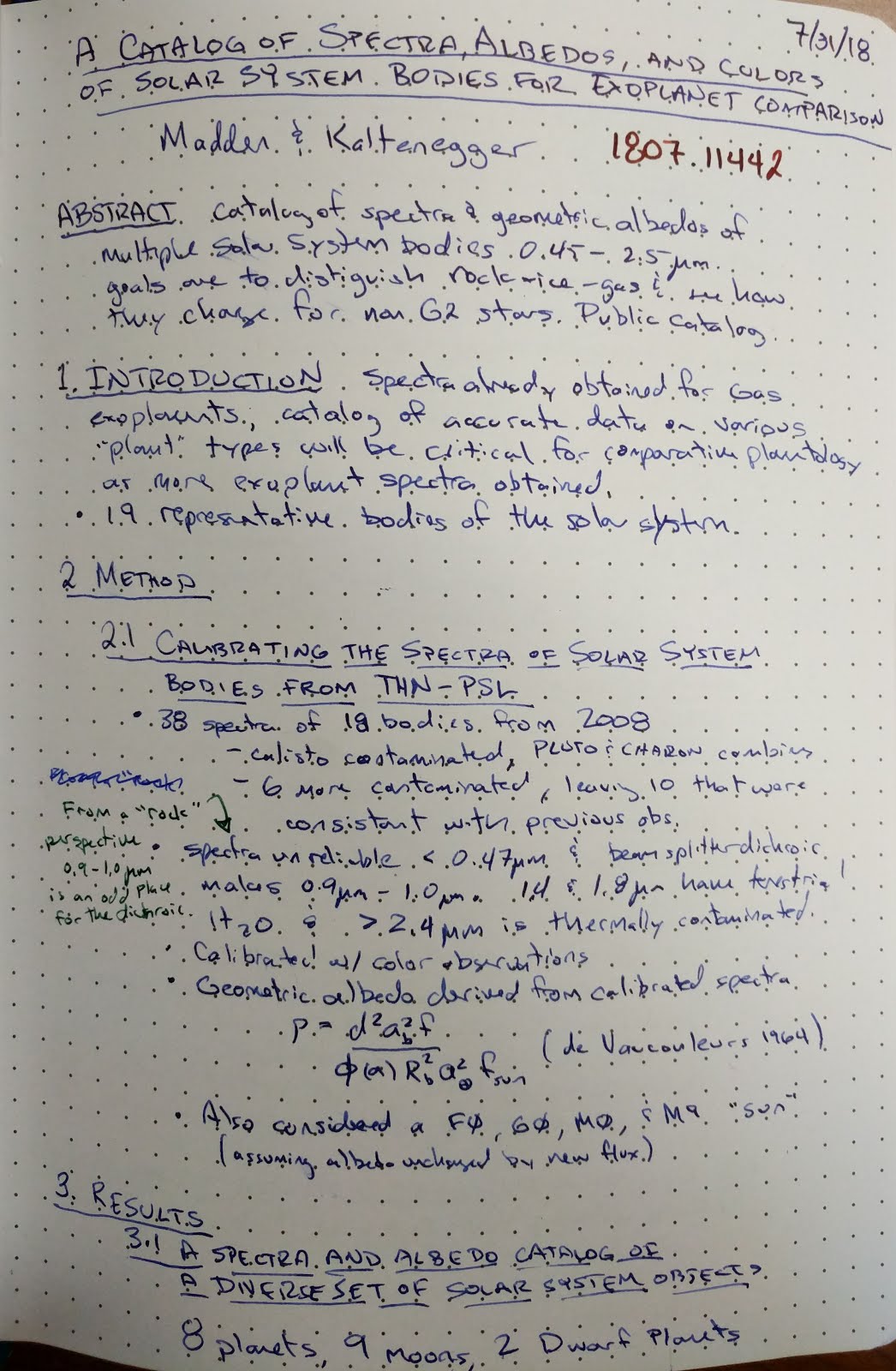
arXiv:1807.11442 - A Catalog of Spectra, Albedos, and Colors of Solar System Bodies for Exoplanet Comparison

Paper: A Catalog of Spectra, Albedos, and Colors of Solar System Bodies for Exoplanet Comparison
Authors: J. H. Madden, Lisa Kaltenegger
Abstract: We present a catalog of spectra and geometric albedos, representative of the different types of Solar System bodies, from 0.45 to 2.5 microns. We analyzed published calibrated, un-calibrated spectra, and albedos for Solar System objects and derived a set of reference spectra and reference albedo for 19 objects that are representative of the diversity of bodies in our Solar System. We also identified previously published data that appears contaminated. Our catalog provides a baseline for comparison of exoplanet observations to 19 bodies in our own Solar System, which can assist in the prioritization of exoplanets for time-intensive follow-up with next-generation Extremely Large Telescopes (ELTs) and space-based direct observation missions. Using high and low-resolution spectra of these Solar System objects, we also derive colors for these bodies and explore how a color-color diagram could be used to initially distinguish between rocky, icy, and gaseous exoplanets. We explore how the colors of Solar System analog bodies would change when orbiting different host stars. This catalog of Solar System reference spectra and albedos is available for download through the Carl Sagan Institute.

My Comment: This is cool stuff. In order to have a clue as to what we will (soon) be looking at in terms of exoplanets we need to know what the worlds that we have access to would look like as exoworlds. This (public) catalog is a nice first step. Clearly acknowledging several issues that arose in making it, it lays out a nice guideline as to how to make a first-pass at guessing if you are looking at a rocky or icy surface, or at a whole bunch of gas.  Also: Venus is hard.

My Scrawling Notes:
Friday, July 20, 2018

arXiv:1807.07557 -- WASP-128b: a transiting brown dwarf in the dynamical-tide regime

Paper: WASP-128b: a transiting brown dwarf in the dynamical-tide regime
Authors: V. Hodžić, et al.
Abstract: Massive companions in close orbits around G dwarfs are thought to undergo rapid orbital decay due to runaway tidal dissipation. We report here the discovery of WASP-128b, a brown dwarf discovered by the WASP survey transiting a G0V host on a 2.2d orbit, where the measured stellar rotation rate places the companion in a regime where tidal interaction is dominated by dynamical tides. Under the assumption of dynamical equilibrium, we derive a value of the stellar tidal quality factor logQ′⋆=6.96±0.19. A combined analysis of ground-based photometry and high-resolution spectroscopy reveals a mass and radius of the host, M⋆=1.16±0.04M⊙, R⋆=1.16±0.02R⊙, and for the companion, Mb=37.5±0.8MJup, Rb=0.94±0.02RJup, placing WASP-128b in the driest parts of the brown dwarf desert, and suggesting a mild inflation for its age. We estimate a remaining lifetime for WASP-128b similar to that of some ultra-short period massive hot Jupiters.

My Comment: I honestly didn't know (or had forgotten) that brown dwarf companions were very rare around solarish stars. I enjoyed the mix of observations, dynamic theory, and computational modelling all nicely fit together.

My Scrawling Notes:

Wednesday, June 27, 2018

Special cases : moons, rings, comets, trojans; arXiv:1806.10032

Paper: Special cases: moons, rings, comets, trojans
Authors: Juan Cabrera, Maria Fernandez Jimenez, Antonio Garcia Munoz, Jean Schneider
Abstract: Non-planetary bodies provide valuable insight into our current under- standing of planetary formation and evolution. Although these objects are challeng- ing to detect and characterize, the potential information to be drawn from them has motivated various searches through a number of techniques. Here, we briefly review the current status in the search of moons, rings, comets, and trojans in exoplanet systems and suggest what future discoveries may occur in the near future. .

My Comment: Nice quick review - actually an (intro?) chapter for a larger review. Although posted to astro-ph today, the article is only current through mid 2017, and makes many references to the other chapters of the larger review series. Takeaway: we are in an era where smaller than planetary objects (rings, comets, moons, etc) may potentially be found around other star systems, but it is going to be a monumental task to cleanly separate an unambiguous signal of such from various systematics of the observations, and the fickleness of stars.

My Scrawling Notes: